Krinea

Systematic reviews: the AI extracts the data, you verify it.

Krinea keeps your whole systematic review in one place, from importing references to the PRISMA 2020 diagram. For extraction, the AI fills in your form and quotes the exact sentence behind each value, so you only have to check. Open source, alone or as a team.

No credit card. AGPL-3.0. Hosted in Frankfurt (EU) or on your own server.

krinea.org/app/reviews/solar-mini-grids/screening
Title and abstract22 / 51 screened by you
2017
Energy Policy
Web of Science
Include

Comparing grid extension and solar mini-grids for last-mile electrification in Ethiopia

Tesfaye, Hanna; Haile, Meron; Walsh, Declan

Ethiopia plans to reach universal access by extending the national grid, yet many settlements lie far from existing lines. We compare the cost of grid extension and of solar mini-grids for 1,860 unelectrified settlements using a geospatial least-cost model with settlement-level demand estimates.

Exclusion reason
Note
IncludeIMaybeMExcludeE

I include · M maybe · E exclude
Live demo built from the real screening view, on a sample review of 55 fictitious records.

Licence
AGPL-3.0, engine under MIT
Imports
RIS, BibTeX, PubMed, Web of Science, CSV, TSV, Excel
Screening
Alone or as a team, blind, with disagreements handled
Hosting
Frankfurt (EU), or your own server

Krinea in 40 seconds

One complete review, from import to PRISMA diagram.

The screens are the real application, on a sample review of 55 fictitious records. No sound.

Video made from real screenshots of the application. Names, papers and figures are fictitious.

One review, five stages.

A systematic review goes through five stages, and Krinea keeps them in one workspace from which everything can be exported at any time. The screens below are the real application, on a sample review of 55 fictitious records.

Stage 1 of 5

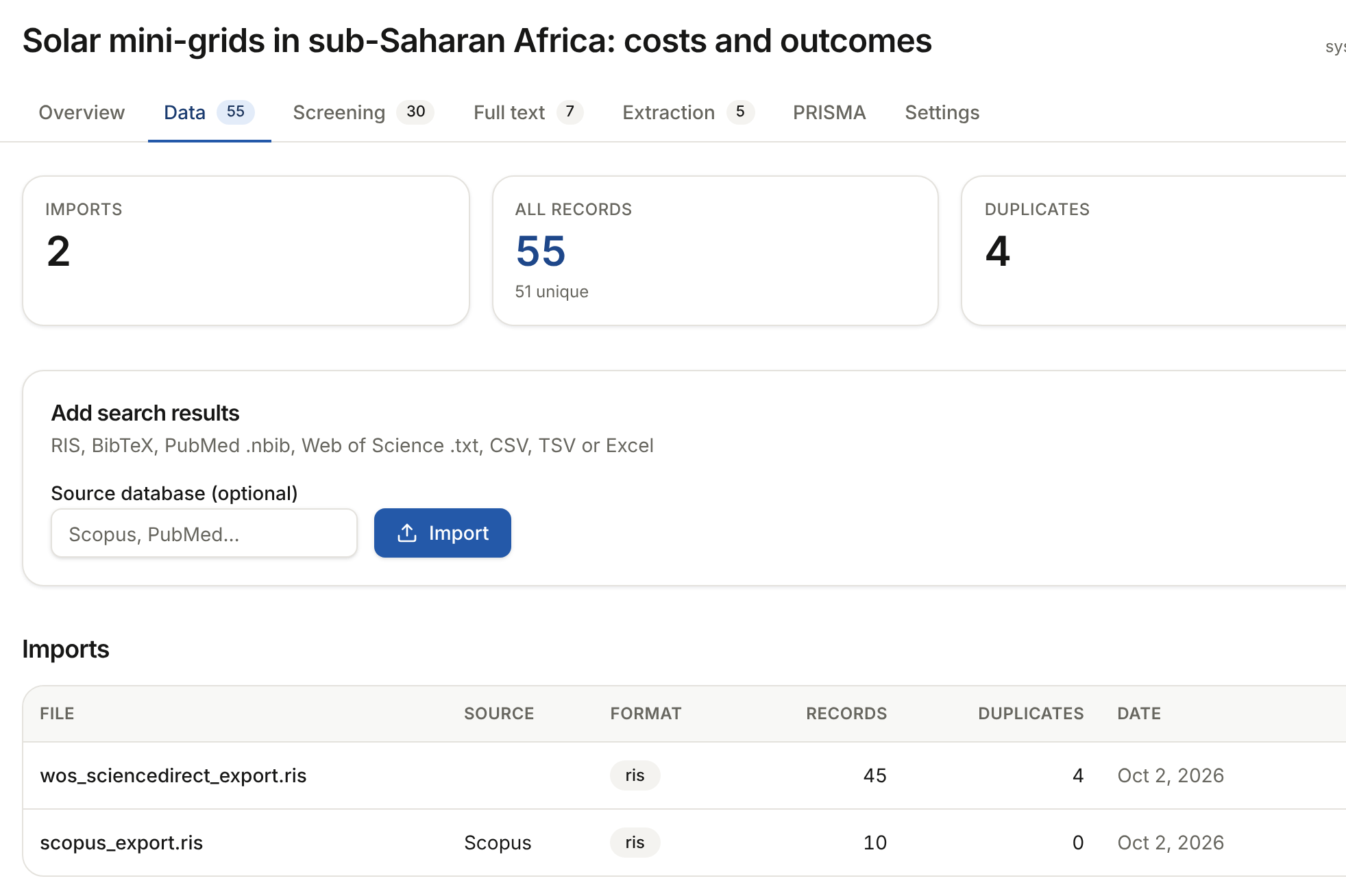
Import every search export.

  • Drop in your RIS, BibTeX, PubMed, Web of Science, CSV, TSV or Excel files: the format is recognised on upload.
  • Each file is kept as a separate batch, with its source database and the date it came in.
  • From that first import, the counts per source start feeding the PRISMA diagram.
krinea.org/app/reviews/solar-mini-grids/data
Data page of a review: three count tiles, the import box and a table of two imported files
A researcher reading on a laptop at a library desk, open books beside him

Reading at a library desk. Photo: Tima Miroshnichenko, Pexels.

Built by a researcher who needed it.

Krinea began as a script written during a real systematic review on long-term energy-system models in Africa. Its author needed to pull structured data out of hundreds of PDFs without losing track of where each value came from. The script grew a form, then a quote next to every value, then a screening step so the same team could decide which papers to read at all.

Today Krinea is an independent open-source project maintained by one developer-researcher based in France, with no company behind it. The hosted edition runs in Frankfurt and is free while it is in beta. The code is AGPL-3.0, so whatever happens to the hosted edition, you can run it yourself.

Read the full story

Two colleagues going through a printed report together at a desk

Photo: Kaboompics, Pexels.

Built for teams, disagreements included.

Most reviews are done by several people, and that is exactly what Krinea was designed for. Each reviewer works on their own, blind if the review calls for it, and the disagreements are then gathered in one list where they can be settled with full context, while everyone's progress stays visible.

  • Single or double screening, chosen per review, whatever the size of the team.
  • Blind mode applies at every stage, on title and abstract as on full text.
  • A disagreement is settled with both decisions and their reasons on screen, and the final call is logged.

Invite a colleague from the review settings

Six things Krinea will not change its mind about.

The AI suggests. A person decides.

Its suggestions are stored apart from the decisions, so they never count as one until someone has made them their own.

Every decision keeps its reason.

Whether it is an inclusion, an exclusion or a doubt, the reason, the author and the time go into a log you can export.

Double screening is blind.

Each reviewer decides without seeing the other's choice, and only once both decisions are in do the disagreements show up.

Your data leaves when you want.

References, the decision log, extractions and the PRISMA diagram export as RIS, CSV or Excel, at any time and without a subscription.

Open source, for good.

The application is released under AGPL-3.0 and the engine under MIT, so you can host it yourself with Docker Compose or the Render blueprint.

In French and in English.

The interface, the e-mails and this site were written in both languages, separately rather than machine-translated.

A hand highlighting a passage in a textbook with a teal highlighter

Photo: Kaboompics, Pexels.

Built in the open.

Krinea is at version 0.1.0. Every change is public. The three most recent, from the repository:

  1. New public site: blue palette, real screenshots, photographs and a live screening demo.

  2. Stored PDFs are deleted together with their review, records or import.

  3. The worker purges old sign-in tokens and expired sessions every hour.

All releases on GitHubRoadmap and open issues

Questions people ask first.

Anything else: write to us or open a discussion on GitHub.

Is it free?

Yes. While Krinea is in beta, the hosted edition is free with every feature, and self-hosting will stay free whatever happens. The Pro and Institution plans will only open once billing and the legal documents are ready, and nothing is charged unless you subscribe yourself.

Where is my data stored?

Your data is hosted in Frankfurt, Germany, on servers run by Render. If you install Krinea on your own infrastructure, it stays wherever you put it. The privacy policy details what is kept and for how long.

Can I import from Zotero, EndNote or Mendeley?

Yes, through an export. Your reference manager can produce a RIS or BibTeX file, which Krinea reads directly, as it does PubMed, Web of Science and Scopus exports. A direct Zotero connection does not exist yet.

What happens when two reviewers disagree?

The record is then flagged as a disagreement. Both decisions appear side by side with their reasons, and the person responsible for the review makes the final call. Every vote stays in the decision log.

Does the AI decide anything?

No. It proposes a decision with a reason, or fills in an extraction form quoting a passage for each field, but its proposals are stored apart and only a person can include, exclude or validate. You use your own API key for this.

Can I self-host it?

Yes. The repository ships a Docker Compose file and a Render blueprint, and since the application is under AGPL-3.0 and the engine under MIT, nothing stops you from installing it on your own servers.

Start your first review. It is free.

Import a first search export, invite a colleague if you like, and move forward knowing that everything stays exportable, from day one.